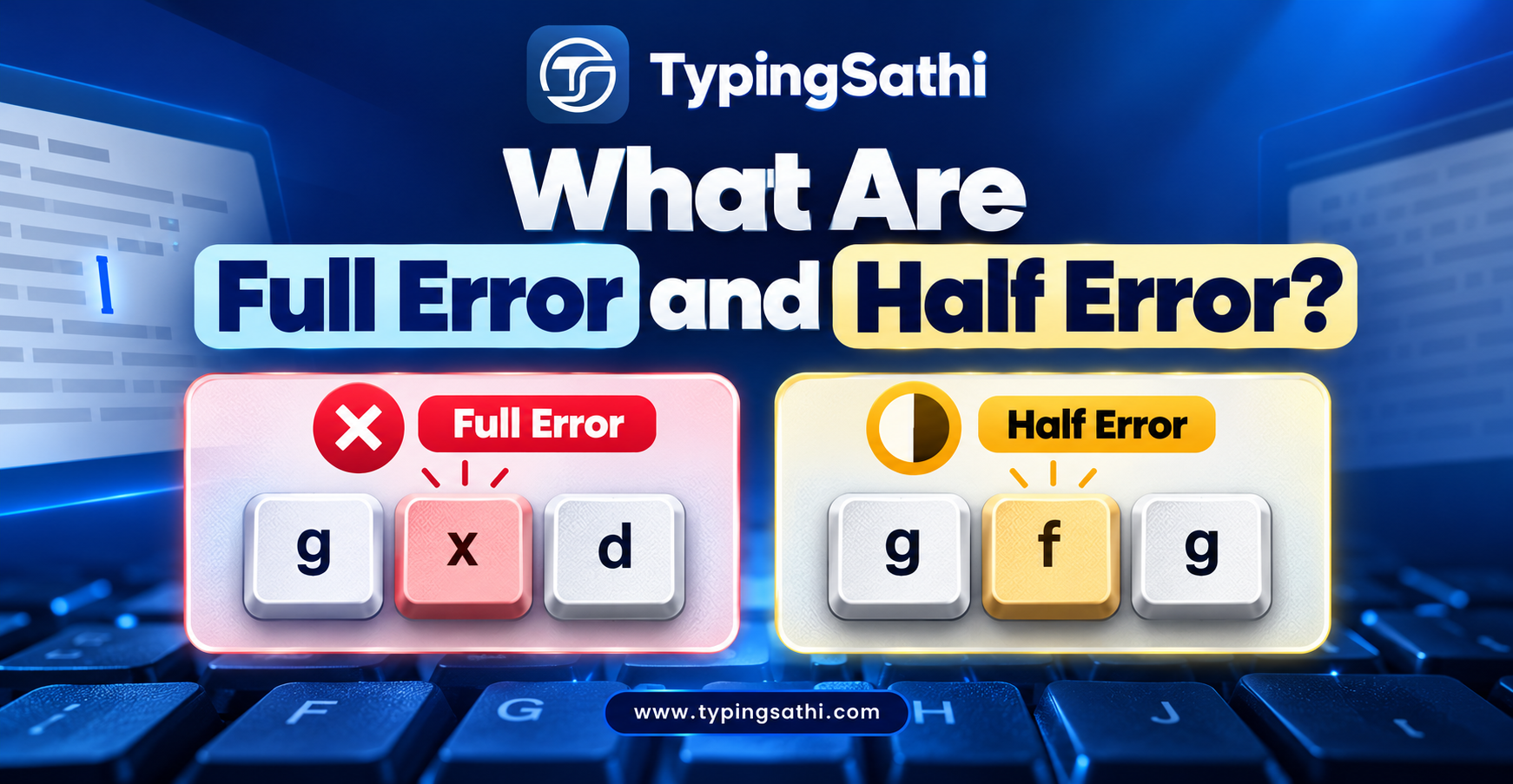
Full Mistakes (Full Errors) With Examples
A full mistake changes the content of a word, so the whole word is counted as wrong. These are the six most common kinds.
| Type of full mistake | What it means | Original text | What you typed |
|---|---|---|---|
| Omission | A word or figure is skipped | The office opens at nine | The office opens nine |
| Substitution | A different word or figure replaces the correct one | Submit the report today | Submit the letter today |
| Addition | An extra word or figure is inserted | Please sign here | Please kindly sign here |
| Spelling mistake | One or more letters in a word are wrong | government | goverment |
| Repetition | A word is typed twice in a row | Read the notice carefully | Read the the notice carefully |
| Incomplete word | A word is left unfinished | application | applica |
Every row above is one full error, however small the slip looks. A single missing letter turns the word into a different string, and the checker treats it as a wrong word.
Half Mistakes (Half Errors) With Examples
A half mistake leaves the word itself intact but gets its format, spacing or position wrong, so it is counted as half the penalty of a full mistake.
| Type of half mistake | What it means | Original text | What you typed |
|---|---|---|---|
| Missing space | Two words are joined together | Send it now | Sendit now |
| Extra space | A gap appears inside a word or between words | Please wait | Pl ease wait |
| Wrong capitalisation | A capital letter becomes small, or the reverse | Meet me in Jaipur | Meet me in jaipur |
| Punctuation error | A comma, full stop or other mark is missing, extra or changed | Yes, I agree. | Yes I agree |
| Transposition | Two neighbouring words swap places | Pay the fees online | Pay fees the online |
Two things to remember. Capital letter rules do not apply when typing in Hindi, because the script has no upper and lower case. And some exams treat swapped words or paragraph breaks differently, so the official notification always has the final say.
How Full and Half Errors Are Calculated
A full error is worth one mistake and a half error is worth half a mistake, so two half errors equal one full error.
| Point | Full error | Half error |
|---|---|---|
| Nature of slip | Word is wrong, missing, extra or incomplete | Word is right but spacing, case or punctuation is off |
| Penalty (word method) | 1 mistake | 0.5 mistake |
| Penalty (keystroke method) | All keystrokes of the word | Half the keystrokes of the word |
| Example word: Accuracy (8 keystrokes) | 8 error keystrokes | 4 error keystrokes |
Some exams count errors by words and others by keystrokes, but the idea is the same: half errors cost half as much as full errors.
Worked example
Suppose the passage has 400 words and you finish with 6 full errors and 4 half errors.
| Step | Working | Result |
|---|---|---|
| Convert half errors | 4 ÷ 2 | 2 |
| Total errors | 6 + 2 | 8 |
| Error percentage | (8 ÷ 400) × 100 | 2% |
| Accuracy | 100 − 2 | 98% |
The maximum error percentage allowed differs by exam and post, so compare your own result with the limit in the current notification.
7 Practical Tips to Reduce Full and Half Errors
- Build accuracy before speed. Raise your speed only once you can type a passage with very few errors.
- Read a few words ahead of where you are typing, so you spot tricky words and punctuation early.
- Type exactly what is printed, including capital letters, commas and full stops, even if you would write it differently.
- Press the space bar once after each word and punctuation mark, never twice.
- Keep your eyes on the passage, not the keyboard, and practise proper finger placement on the home row.
- If you finish early, use the remaining time to proofread and fix mistakes instead of retyping.
- Review your error report after every practice test, and note which type of error you repeat most.
Why Students Practise on TypingSathi
Students choose TypingSathi because it lets them practise full and half errors in the same kind of environment they will face on exam day. Here is what sets it apart.
| Feature | What it does | Why it helps you |
|---|---|---|
| Real exam interface | Recreates the look and layout of the actual typing test screen | You feel at ease on exam day because nothing looks new |
| Precise error counting | Counts full errors and half errors separately | You see exactly where marks are lost and what to fix |
| Live speed and accuracy tracking | Shows your speed and accuracy as you type | You can balance pace and precision while practising |
| Authentic typing sounds | Plays realistic keyboard sounds during the test | You get used to the exam hall atmosphere |
| Exam hall simulation | Practice under timed, test-like conditions | You build the focus and stamina needed for the real paper |
| Step-by-step lessons | Guided practice from basics to exam level | Beginners can improve in a structured way |
| Performance analytics | Reports on your progress over time | You can track improvement and plan your next practice |
| Exam coverage | Built for SSC, Railway and state government typing exams | One platform for the exams you are preparing for |
| Free trial | You can try it before you commit | You can test the experience at no cost |
Students can also follow the official WhatsApp and Telegram channels for exam alerts, rules, daily targets and offers.
Conclusion
Full errors and half errors decide whether your typing speed counts, so learning the difference is as important as practising the keys. Aim for clean, exact typing first, review each error report, and let your speed grow on top of that accuracy. Start practising today on TypingSathi and see your full and half errors counted the way the real test counts them.